What the Research Says About Effective Revision Strategies

Owais Bagwan
Consultant
Most students revise. The question is not whether they do it but how. Two decades of research on learning techniques has produced an unusually clear answer to that question, and it conflicts significantly with how most students actually study.
For teachers, this matters at two levels: what to advise students to do independently, and how to design classroom practice to reinforce the methods the evidence shows produce lasting learning, not just short-term familiarity.
The hierarchy: what a major review of study techniques found
In 2013, psychologist John Dunlosky and colleagues published a systematic review of ten learning techniques widely used by students. They evaluated each against four categories of variable: the learning conditions, student characteristics, the type of material, and the outcome being measured. Two techniques received a high utility rating: practice testing (retrieval practice) and distributed practice (spaced revision). Five received a low utility rating. Among the low-rated techniques: summarisation, highlighting and underlining, and rereading.
The finding that has most shaped subsequent research is this: the strategies students reach for most commonly are largely the ones the evidence rates as least effective. Rereading produces familiarity, which students mistake for learning. Highlighting feels active and productive. But neither requires the effortful retrieval that produces durable memory. Students walk away from a rereading session feeling prepared. The knowledge is not there when the exam begins.
Retrieval practice: what the evidence actually shows
Roediger and Karpicke's 2006 study established the core finding: students who tested themselves on material significantly outperformed those who simply reread it, particularly when tested a week or more later. The size of the advantage increased as the delay between study and test grew, which is precisely the condition that matters for GCSEs.
The effect has since been confirmed at substantial scale. A 2021 meta-analysis by Yang and colleagues reviewed 222 classroom studies involving 48,478 students and found that regular low-stakes testing raised academic achievement by an average of close to half a standard deviation (g = 0.499). In educational research, where effects above 0.4 are considered large, this places retrieval practice among the highest-impact, lowest-cost interventions available. It requires no additional time, equipment or resource. It requires a change in format.
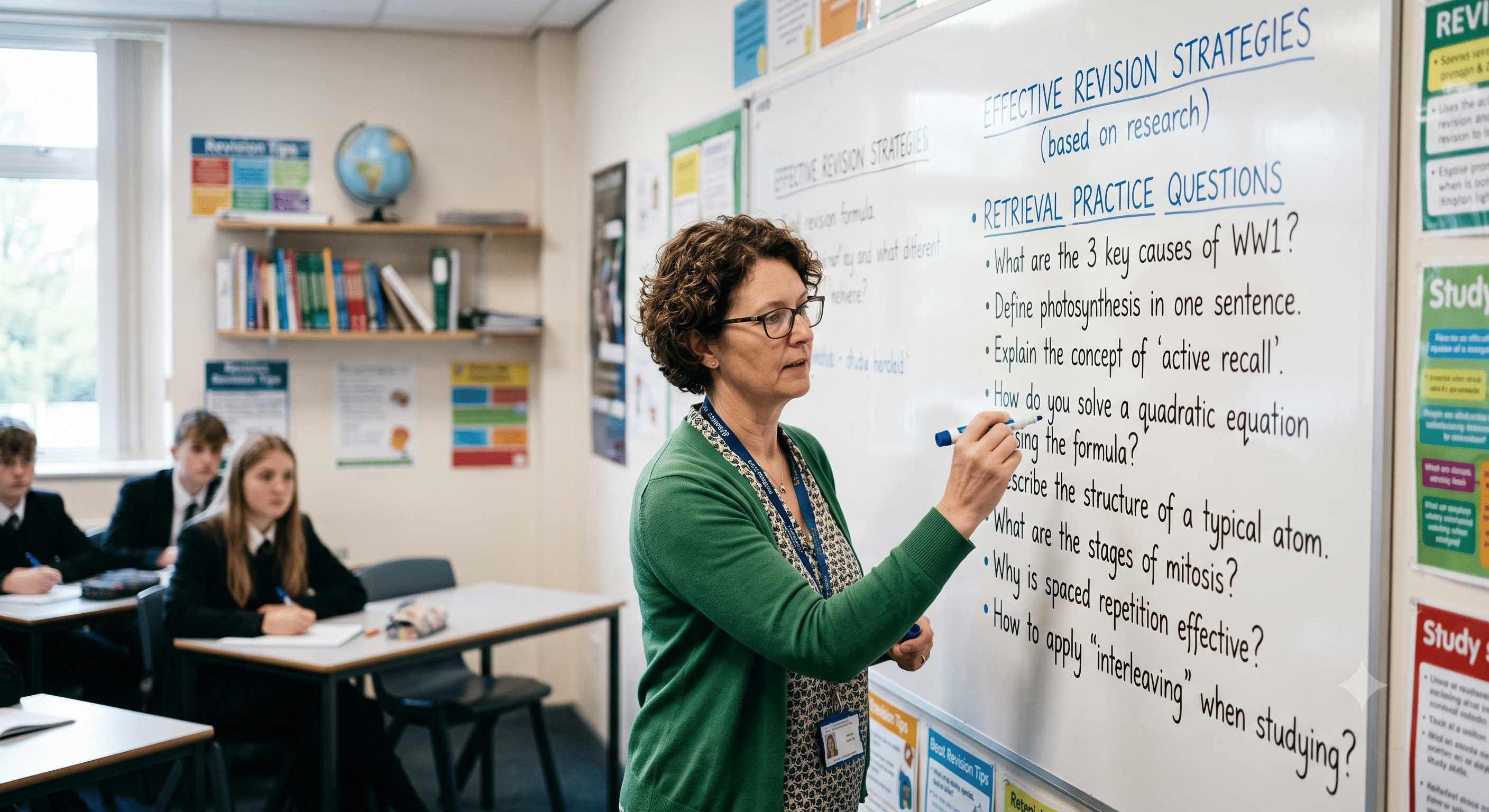
What retrieval practice looks like in a lesson: Low-stakes quiz at the start of a lesson revisiting material from two lessons ago, not the previous one. Students write down everything they remember about a topic before opening their notes. Flashcard-based self-testing: statement on one side, attempt to recall before turning over. A practice question answered without reference materials, then compared against a mark scheme. |
Spaced practice: why timing matters as much as technique
Retrieval practice works better when it is distributed over time. Cepeda and colleagues' 2006 meta-analysis of 317 studies found that the same total amount of practice produces significantly stronger long-term retention when spread across multiple sessions than when concentrated in a single block.
This is counterintuitive in a way that creates real problems for revision planning. Students feel like they remember material better immediately after an intensive single session, and they are right in the short term. The issue is that memory decays faster from a single session than from spaced revisits, and the test comes later. A student who reads through all their chemistry notes on Sunday will outperform a student who revisits chemistry four times across a fortnight at the end of that Sunday. They will underperform the same student by the time the exam arrives.
For teachers setting revision tasks: the instruction to “revise chemistry this week” produces a different learning outcome than “revisit the first topic on Tuesday, the second on Thursday, test yourself on both on Saturday.” The interval is part of the intervention.
Interleaving: mixing problems rather than blocking by topic
A further finding concerns how practice problems are sequenced. When students work through a block of problems of the same type, performance during practice is higher. When problems are mixed across topics or question types, performance during practice feels harder and less smooth. Long-term retention and transfer are significantly stronger in the interleaved condition.
In the largest classroom study on this question to date, Rohrer, Dedrick, Hartwig and Cheung (2020) randomly assigned 787 students across 54 classrooms to interleaved or blocked mathematics practice. The interleaved group outscored the blocked group by a large margin at the follow-up test, with an effect size of d = 0.83. The mechanism is relatively straightforward: when problems are mixed, students must identify which strategy to use before they can apply it. This is exactly the demand placed on them in an exam. Blocked practice removes that demand from practice, so students never develop it.
Why interleaving feels harder, and why that matters: Students consistently rate interleaved practice as more difficult than blocked practice. Cognitive psychology calls this a ‘desirable difficulty’: the added challenge of retrieval during practice is what accelerates long-term retention. The practical implication for homework design: mixing question types across topics within a single task tends to produce more learning than a task focused on a single recent topic, even if the mixed task feels less tidy. |
Teaching students how to study: metacognition and the EEF
The Education Endowment Foundation's Teaching and Learning Toolkit rates metacognition and self-regulation, the set of skills involved in students planning, monitoring and evaluating their own learning, as equivalent to seven months' additional progress over the course of a year. This figure was reaffirmed in the EEF's updated guidance in November 2025.
A significant component of effective metacognitive instruction is explicitly teaching students which study strategies work and why, so they can make better independent decisions. This is not a pastoral conversation. It is a teaching intervention with a strong evidence base. Students who understand that rereading produces familiarity rather than learning are more likely to use retrieval-based methods when revising independently, because the rationale is visible to them.
What this means in practice
For classroom teachers: spacing retrieval across lessons rather than concentrating it on one revision session; using low-stakes quizzes at the start of lessons to test prior material; mixing question types within homework tasks rather than assigning single-topic sets; and explicitly telling students why you are making these design choices.
For departments: the format of a homework task matters as much as the volume. A task that asks students to write down everything they remember from the previous unit, without their notes, before checking and correcting produces more learning than a task asking them to read through a summary and underline key terms.
For school leaders: revision strategy instruction is a form of curriculum design. Schools that embed retrieval-based approaches across departments, rather than treating them as individual teacher preference, produce more consistent learning outcomes at GCSE.
BrainStrata's practice model is built around these principles: retrieval-based questions, spaced review intervals, and interleaved subject coverage rather than topic-blocked repetition, applied adaptively across the curriculum.
Sources and further reading
Dunlosky, J., Rawson, K. A., Marsh, E. J., Nathan, M. J., & Willingham, D. T. (2013). Improving students’ learning with effective learning techniques. Psychological Science in the Public Interest, 14(1), 4–58.
Roediger, H. L., & Karpicke, J. D. (2006). Test-enhanced learning: Taking memory tests improves long-term retention. Psychological Science, 17(3), 249–255.
Yang, C., Luo, L., Vadillo, M. A., Yu, R., & Shanks, D. R. (2021). Testing (quizzing) boosts classroom learning: A systematic and meta-analytic review. Psychological Bulletin, 147(4), 399–435.
Cepeda, N. J., Pashler, H., Vul, E., Wixted, J. T., & Rohrer, D. (2006). Distributed practice in verbal recall tasks: A review and quantitative synthesis. Psychological Bulletin, 132(3), 354–380.
Rohrer, D., Dedrick, R. F., Hartwig, M. K., & Cheung, C.-N. (2020). A randomized controlled trial of interleaved mathematics practice. Journal of Educational Psychology, 112(1), 40–52.
Education Endowment Foundation, Teaching and Learning Toolkit: Metacognition and Self-Regulation (updated guidance, November 2025).
Frequently asked questions
Retrieval practice involves actively recalling information from memory, through self-testing, practice questions, or flashcards, rather than reviewing it passively. The difference is the direction of effort: retrieval requires the brain to find and reconstruct information; rereading allows recognition of information already present on the page. Recognition produces familiarity. Retrieval produces durable memory. The two feel similar during revision but produce very different results in an exam.
Ready to boost your GCSE results?
Join thousands of students using BrainStrata's AI-powered personalised learning to master their KS3 and KS4 curriculum.
.png)